
If you spend any time reading about ketamine-assisted psychotherapy, you will very quickly come across the word “integration”. It is one of the most commonly used terms in this area of treatment, but it is also one of the least consistently defined. Different clinics, therapists and treatment models can mean quite different things when they use it, which can make it difficult for somebody considering treatment to understand what they are actually being offered.
For some providers, integration may mean a short conversation after the ketamine session. For others, it may involve journalling, mindfulness, coaching, psychotherapy, group work or a structured therapeutic programme. Some therapists work with the experience immediately, while others prefer to allow time for it to settle before returning to it in a later session. There is no single universally accepted definition, and there is currently no evidence showing that one integration model is the only correct way of working.
At The Emerge Clinic, we use the term in a fairly specific way. For us, integration is the psychotherapy that helps a person make sense of what has emerged during or after a ketamine session and connect it with their wider
psychological life. The aim is not simply to discuss what happened, but to explore whether the experience offers anything useful that can be understood, developed and applied in a way that supports lasting change.

The Ketamine Experience Is Not the Same Thing as Integration
A ketamine session can sometimes be psychologically powerful. People may experience emotions differently, see familiar problems from an unfamiliar perspective, remember events they have not thought about for years or suddenly understand a pattern in themselves that had previously made very little sense. Other sessions can be quieter, less visual or much harder to interpret.
A powerful experience can feel therapeutic in its own right, but the experience itself is not necessarily the same thing as psychotherapy. Insight does not automatically produce change. Most people can probably think of something they understand perfectly well about themselves but continue doing anyway.
That distinction is important. Somebody may realise during a session that they have spent much of their life trying to gain approval from other people, for example. That realisation might feel enormously important at the time, but the therapeutic work begins when we start asking what that pattern looks like in everyday life, where it may have come from, what function it has served and what would need to happen for it to change.
Integration therefore involves more than asking somebody what they saw or experienced. We are interested in what the experience might mean to that individual, how it relates to their history and current difficulties, and whether it gives us a useful route into deeper therapeutic work.
Why Can the Period After Ketamine Be Important?
Ketamine produces rapid changes in the way the brain processes information and can temporarily alter perception, emotional responses and the way thoughts and memories are experienced. Research has also focused on ketamine’s effects on neuroplasticity, which broadly refers to the brain’s capacity to adapt, learn and form new patterns.
This has led to considerable interest in the period following treatment. One of the ideas underpinning ketamine-assisted psychotherapy is that a period of increased psychological flexibility may create an opportunity for therapeutic work. Somebody who has been stuck in a very rigid pattern of thinking may temporarily find it easier to look at that pattern differently, while emotions or memories that have normally been difficult to access may feel less defended against.
The science in this area is still developing, and it would be misleading to suggest that we know exactly how long this period lasts, precisely how it should be used or which form of psychotherapy is definitively best. Different research studies have used different types of therapy, different timings and different treatment structures.
Our approach is therefore based on a combination of the available evidence and established psychotherapeutic principles. If somebody has experienced a meaningful shift in perspective, emotional openness or psychological flexibility, it makes sense to explore that while it is still fresh rather than simply waiting for the next ketamine session.
What Actually Happens in an Integration Session?
At The Emerge Clinic, an integration session is a psychotherapy session. It is not simply a debrief, and it is not a process of analysing every image or sensation that appeared during the ketamine experience.
The starting point is usually whatever the person noticed during the session or in the hours and days afterwards. Sometimes there is something very obvious to work with. A person may have experienced a strong memory, a particular emotion or a clear realisation about themselves. At other times, the material may be much less clear.
Our job is not to tell somebody what their experience means. If somebody sees a red door during a ketamine session, we do not consult an imaginary handbook and announce that red doors represent unresolved anger towards their father. The interesting question is what that red door meant to them, if anything at all.
We might explore what they felt when they saw it, what associations came with it, whether it reminded them of anything, and whether the emotions connected with it resemble anything from their wider life. The same experience could mean something completely different to two different people, which is why interpretation needs to come from the person rather than being imposed by the therapist.
Integration also does not require a dramatic ketamine experience. Some of the most useful therapeutic work can come from small shifts. Somebody may notice that a familiar thought suddenly felt less convincing, that they were able to look at a difficult memory without becoming overwhelmed, or that they experienced compassion towards themselves where they would normally experience criticism.
Those changes may appear fairly modest compared with a dramatic altered-state experience, but they can provide very useful therapeutic material.
How We Approach Integration at The Emerge Clinic
The Emerge programme is deliberately psychotherapy-led. It includes six medically supervised intramuscular ketamine sessions and six dedicated integration sessions, alongside psychological and medical assessment, therapeutic support and personalised resources.
Our main integration sessions usually take place around 48 to 72 hours after the ketamine session. This gives the immediate effects of the ketamine time to resolve and allows the experience to settle. People often notice further thoughts, feelings or memories during the following day or two that were not particularly clear immediately after treatment.
Somebody may find that a phrase from the session suddenly makes sense the following morning. A memory might return unexpectedly. They may notice that they react differently to a familiar situation, or they may simply become aware that a long-standing belief about themselves feels slightly less certain than it did before.
These observations can then be brought into the next psychotherapy session and explored in a more grounded way. There is no requirement to arrive at integration with something profound to report, and nobody is expected to produce a revelation after every ketamine session. If somebody feels that nothing particularly happened, that is still a perfectly reasonable place to begin.

Different People Need Different Forms of Therapy
There is no single school of psychotherapy that we apply to every person in exactly the same way. Our approach is integrative, which means that the therapeutic method is guided by the needs of the individual rather than by loyalty to one particular model.
Depending on the person and what emerges during treatment, the work may draw on attachment-focused psychotherapy, trauma-informed approaches, Internal Family Systems concepts, experiential psychotherapy, ACT, parts work and other established psychological methods.
One person may find that a childhood memory suddenly carries much more emotional significance than they previously realised. Another may become aware of an internal critical voice that has dominated their thinking for years. Somebody else may recognise that a behaviour they always regarded as part of their personality was originally developed as a way of coping with something difficult.
Those are very different therapeutic situations, so it would make little sense to treat them in exactly the same way. The ketamine experience can sometimes help reveal the material, but the psychotherapy is what allows us to examine it properly. We can look at how it developed, why it has been maintained, what purpose it may have served and whether it is still useful now.
Integration Does Not Mean Treating Everything Experienced Under Ketamine as Fact
Ketamine can produce experiences that feel extremely vivid, emotionally powerful and convincing. Something can feel deeply meaningful without necessarily being literally true.
Memories are particularly important in this respect. Human memory is not a perfect recording system, and altered states can produce associations, imagery and reconstructed memories that need to be approached carefully. Responsible psychotherapy should not tell somebody that something definitely happened simply because it appeared during a ketamine experience.
The emotional meaning of the experience may still be very important. A memory, image or feeling can tell us something valuable about the person’s internal world even if we cannot establish whether every detail is historically accurate.
Good integration therefore requires both openness and judgement. We take the experience seriously without automatically treating every interpretation of it as fact.
Integration Is Not About Chasing Increasingly Dramatic Experiences
Some people have a particularly powerful ketamine session and understandably hope that the next session will take them back to exactly the same place. This can create an unhelpful expectation that each treatment needs to be more intense, more visual or more profound than the last.
A dramatic experience is not necessarily a better therapeutic experience. Some very intense sessions produce relatively little lasting change, while quieter sessions can become surprisingly important over time.
The therapeutic question is not simply how extraordinary the session felt. The more useful question is whether anything meaningful changes afterwards.
That change may involve the way somebody thinks about themselves, how they respond emotionally, the choices they make in relationships or the way they behave when an old pattern is triggered.

Insight Matters, but Behaviour Matters Too
Psychotherapy has always had a slightly awkward problem: people can become very good at understanding themselves without necessarily becoming very good at changing themselves.
Somebody may know exactly where their people-pleasing came from, understand their attachment style, recognise why criticism makes them defensive and have a remarkably sophisticated explanation for their relationship patterns. None of that automatically means they will behave differently the next time somebody upsets them.
Eventually, insight has to meet real life.
Integration may therefore involve setting a boundary, having a difficult conversation, allowing an emotion to be felt rather than immediately suppressed, noticing a familiar defensive response before acting on it or doing something that has been avoided for years.
The goal is not to create an endless analysis of the ketamine experience. The goal is to use whatever becomes available in a way that supports psychological and behavioural change.
This is often where the work becomes most interesting. A person may have spent years saying, “I know why I do this,” before eventually reaching the point where they can say, “I noticed myself about to do it again, and this time I did something different.”
That is integration in a much more meaningful sense.
What About Journalling, Meditation and Other Integration Practices?
Integration does not only happen during formal psychotherapy sessions. The days between treatments can also be useful, particularly when somebody remains curious about what they are noticing rather than trying to force an interpretation.
Journalling can help capture thoughts, memories, dreams and changes in perspective that might otherwise be forgotten. Some people find meditation useful, while others benefit from walking, spending time in nature, talking with somebody they trust or simply creating a little more space for reflection.
At The Emerge Clinic, we also use personalised guided meditation and therapeutic audio material where appropriate. These are intended to support the work taking place in therapy rather than replace it.
There can be a temptation to analyse everything after a ketamine session, but not every thought needs to become a therapeutic project. Sometimes the most useful thing somebody can do is sleep properly, eat well, go for a walk and allow the experience to settle. Psychological work does not become more effective simply because it sounds complicated.
How Other Clinics May Approach Integration
Other clinics and therapists may use the term integration very differently, and that does not automatically make their approach wrong.
Some providers offer a short debrief soon after the ketamine session. Others use dedicated integration coaches rather than psychotherapists. Some programmes include group sessions, structured workbooks or mindfulness practices. Other models combine therapy more closely with the ketamine session itself.
There are also differences in timing. Some therapists work immediately after treatment, while others prefer to wait until the following day or several days later. Some programmes offer extensive psychotherapy, while others place greater emphasis on the pharmacological treatment itself.
Several of these approaches have reasonable clinical arguments behind them, and research has not yet established one definitive model that everybody should follow.
This is why it can be useful to ask a clinic what they actually mean when they say their programme includes integration. It is reasonable to ask who provides the integration, what their professional background is, whether the sessions are psychotherapy or coaching, when they happen, how many are included and what therapeutic approach is used.
Those questions will usually tell you far more than the word “integration” on its own.
So What Does Ketamine Integration Actually Mean?
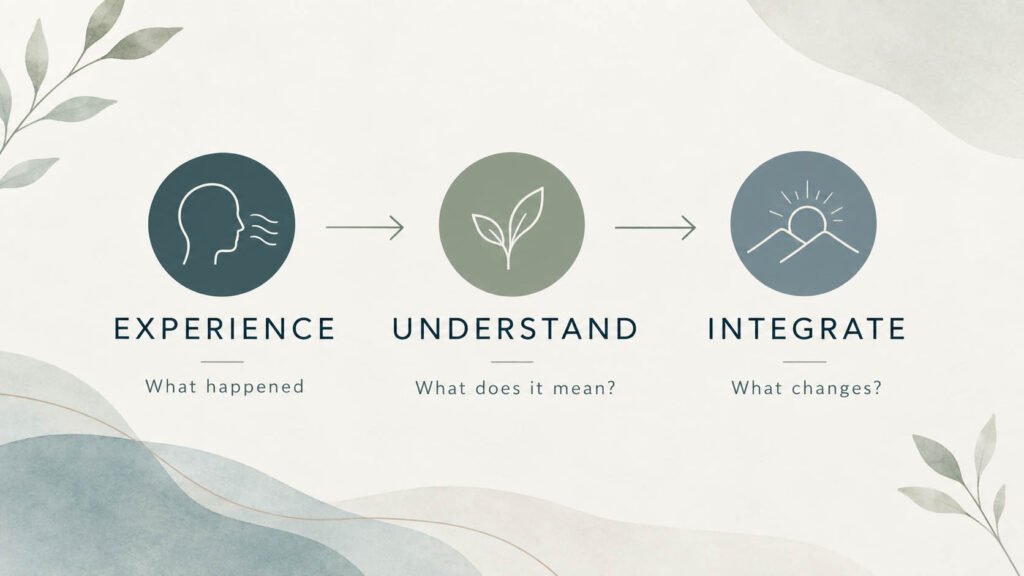
The simplest explanation is that ketamine can create an experience, while integration is the process of understanding what, if anything, can be usefully taken from it.
The ketamine session may offer a new perspective, bring an emotion closer to the surface, make an old pattern easier to see or allow somebody to experience themselves differently for a period of time.
Integration is the slower work of exploring that material, placing it in context and deciding whether it has anything useful to contribute to the person’s wider therapeutic process.
At The Emerge Clinic, we regard integration as psychotherapy. That does not mean we believe ours is the only legitimate way to work. It simply reflects the model we have chosen and the way we believe ketamine and psychotherapy can complement each other.
Ketamine may help create an opening. The therapeutic work is concerned with what happens afterwards.
Considering Ketamine-Assisted Psychotherapy?
The Emerge programme combines psychological and medical assessment, six medically supervised intramuscular ketamine sessions and six dedicated psychotherapy integration sessions, alongside ongoing support and personalised therapeutic resources.
If you would like to understand more about how the programme works, or whether it may be appropriate for you, you are welcome to contact The Emerge Clinic for an initial conversation.